
AUTHOR

I’ve recently finished reading Sapiens: A Brief History of Humankind by Yuval Noah Harari, and it left me pondering something that’s been difficult to ignore.
In the book, Harari maps out the major revolutions that reshaped humanity (cognitive, agricultural, scientific), each one fundamentally changing how we live and think. People living through those times didn’t recognise that anything monumental was happening, they just carried on as normal.
With AI now feeling like it’s worming it’s way to every area of life, it’s hard to imagine that people 100 years from now won’t look back and declare the 2020’s as another turning point in history.
The point where ‘’thinking’’ started becoming optional.
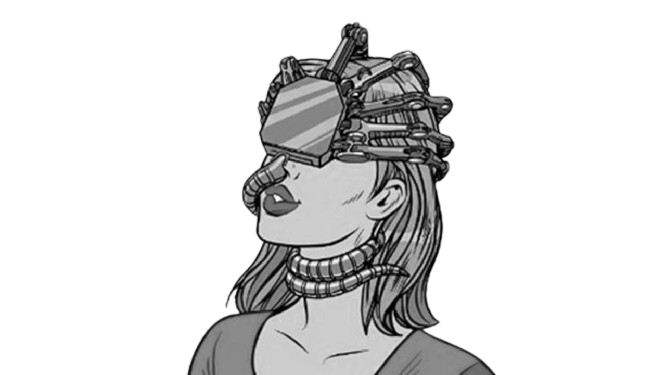
We’re outsourcing our thinking
Apps like ChatGPT and Notebook started off as being really helpful and a novelty to use, but now they just feel like the norm. Instead of starting a project with a blank page, we just ask our apps to write this, summarise that, generate a plan.
The blank page hasn’t disappeared, we’ve just stopped trusting ourselves to fill it.
Somewhere along the way, thinking has become optional. Which raises an uncomfortable question: if AI is doing the thinking, what are we contributing?
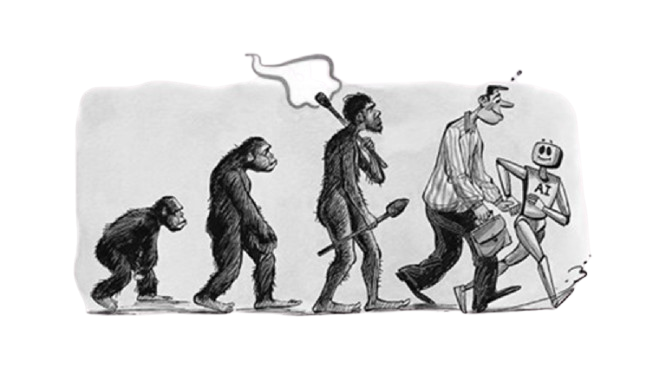 Are we on the precipice of the next stage of humankind?
AI doesn’t create ideas. It remembers.
AI is undeniably impressive, but we have to be honest about what it does well. It doesn’t have ideas in the way humans do, it has references. It’s not creative, it’s just well-read, pulling from patterns, trends, and existing material to produce something that feels new.
In that sense, AI doesn’t invent - it remixes.
That’s why it’s so effective at producing work that feels familiar, polished, and “correct.” But it also explains why it struggles with true originality.
If we’re all using the same tools, trained on the same data, prompted in similar ways… it’s not surprising that everything begins to blur together.
Humans are becoming editors, not thinkers
The creative process itself has changed completely.
Where ideas once started from scratch, they now often begin with options. We scroll, select, tweak, refine, and polish. Most of the time, we’re no longer creating, we’re editing machine-generated output.
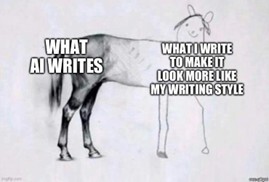
The job subtly shifts from “come up with something interesting” to “make this sound less like AI.”
And with that comes a change in standards. Instead of asking whether something is genuinely good or original, we start asking if it’s simply good enough.
Marketing should be uncomfortable
This matters more than it sounds – especially in marketing.
Marketing isn’t supposed to feel safe. It should challenge, provoke, and create a reaction – make people stop, think, or feel differently. If no one is even slightly uncomfortable, it’s probably not doing very much.
The issue is that AI is built on patterns, and patterns favour what has already worked.
So when AI leads the process, the result is rarely bold. It’s safe, familiar and easy to ignore.
The danger isn’t AI. It’s laziness.
This isn’t a technology problem - it’s a behavioural one.
AI is easy, while thinking requires effort, time, uncertainty, and a willingness to sit with ideas that might not go anywhere. Naturally, humans gravitate toward the shortcut.
But when everyone takes that shortcut, the work begins to flatten. Tone, structure, and ideas start to repeat themselves, and originality gets replaced with variations of what already exists.
This is what happens when you actually think, with no prompts
Here at Sharper, we try to fight that laziness.
When we get a creative brief, we take AI out of the process completely, we call it a Dark Mode Day ™. No distractions, no tools – just the team and the problem at hand.
At first it can feel uncomfortable…sitting alone with your thoughts. But eventually, someone throws out an initial “brain fart,” and that’s usually all it takes to warm the room up. Ideas start bouncing around - some insightful, some ridiculous, and some seemingly irrelevant.
But that’s kind of the point. Original thinking isn’t neat or efficient - it’s messy, uncertain, and occasionally frustrating.
Eventually, (amongst the chaos) fragments of ideas turn into genuine concepts, and the energy in the room shifts. That’s when the magic happens.
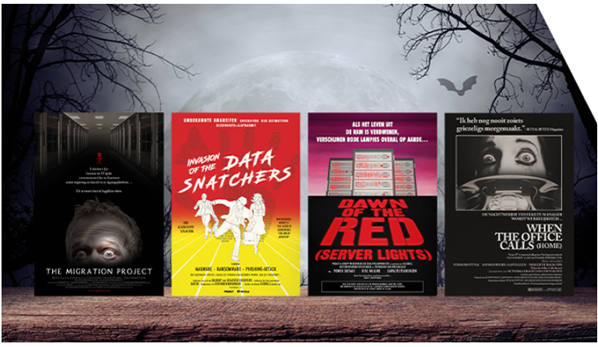
The outcome of a beautifully creative Sharper B2B, Award-winning campaign idea that AI had absolutely nothing to do with.
So what’s the role of AI?
None of this is to say Sharper are anti-AI. Definitely not.
It’s incredibly useful as a sounding board. In many ways, it’s a powerful tool for improving work that already exists.
But it shouldn’t be the starting point, and it shouldn’t be the source of the idea itself.
Creativity isn’t disappearing. It’s being tested.
Creativity isn’t disappearing, it’s a natural, human skill. However, AI is definitely testing it.
Anyone can generate something quickly and it can do an ‘okay’ job.
What matters now is judgment. Is the idea original? Is it relevant? Is it actually worth paying attention to?
Those are the questions that separate meaningful work from noise.
So, is creativity at risk?
Yes, creativity is at risk, but not because AI exists. Simply because we’re choosing not to think for ourselves in the first place.
So let this be your reminder to pick up your pen and paper the next time you are tasked with a project.
Your first idea or thought process might be terrible, but at least that means it’s yours.