

AUTHOR

A Conversation with Elliott King, VP of Marketing at Turtl
There’s a moment in every B2B marketer’s career where they face an existential choice:
Spend your days hiding behind a colourful dashboard of open rates, clicks, and neatly packaged MQLs. Or step into the real world, where the sales team is staring at a pipeline deficit and the CFO doesn’t give a damn how many likes that Linkedin post got.
We’ve all been there, sitting in a meeting room trying to explain why a white paper that got 500 downloads hasn't magically transformed into net-new revenue.
To figure out how we finally break the loop, I sat down with Elliott King, VP of Marketing at Turtl, a company that has built its entire reputation on dismantling standard B2B illusions and replacing them with actual human engagement data, and crucially, commercial results.
Full disclosure: Elliott also happens to be my former boss, so while I’m obligated to respect him, you should too. The guy knows his onions. Look, here’s a picture of Elliott’s face on the Nasdaq board in Time’s Square, after he was named as a GTM10 award winner:

What followed was a masterclass in why traditional B2B marketing structures are crumbling, how AI is actively lowering the floor of our industry, and why your next required reading isn't a marketing textbook - it’s a book on corporate finance.
Leaving the Folklore Debt Behind
We started by addressing a slightly uncomfortable question: why is the average CMO tenure still the shortest in the C-suite?
According to Elliott, the blame lies squarely on a mountain of industry-wide denial:
"We’ve known for a really long time that the funnel and the MQL were built on a lot of mutual shared illusions about how people really buy, especially in technology," Elliott notes. "What Kerry Cunningham calls our 'folklore debt' is coming to an end."
For years, marketing departments have treated the B2B buying journey as a solo sport - track a lead, gate a piece of content, pass it to Sales, clock out. But the reality is far messier.
We are entering the buying group era. People don't purchase complex enterprise software alone; they buy in committees.
"The individuals in those groups have different requirements, different needs," Elliott explains.
"The role of marketing in the next era is really going to be about identifying, aligning, and building consensus with those buying groups."
If your content engine is still optimised to hunt down lone MQLs rather than mapping out the invisible connections within an entire account, you’re entering a chess tournament with a handful of marbles.
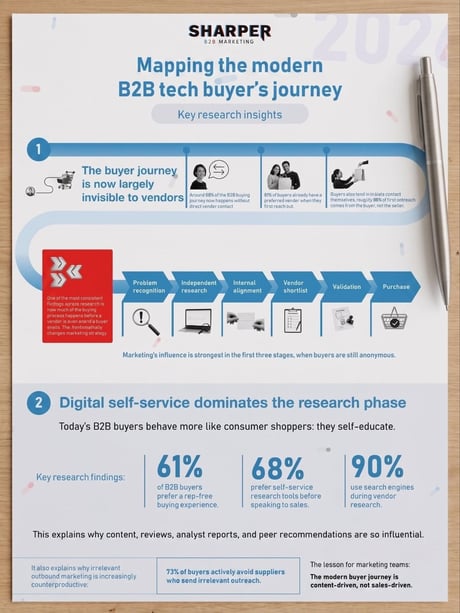
To help you we've pulled together a handy infographic that explains exactly what the modern B2B Buyer Journey looks like. Download it here.
Before the CFO Says GTFO
This shift requires a complete overhaul of how marketing proves its worth to the rest of the business, particularly to the gatekeeper of the budget: the CFO.
If you walk into a budget meeting talking about "brand recall" or "share of voice," you’ve already lost. Finance leaders don't speak marketing; they speak the language of enterprise value.
"We often don't get the credit because we don't report in the language of the other business leaders," Elliott says. "You don't need an MBA to be able to speak the language of finance, but you need to know unit economics. You need to know financial intelligence."
To bridge the gap and become a true commercial marketer, you have to build fluency in the metrics that actually dictate company survival. You need to understand the volatile relationship between your customer acquisition cost (CAC) and customer lifetime value (LTV).
You need to confidently defend return on ad spend (ROAS) and demonstrate how site traffic trends logically convert into downstream pipeline.
When you align your reporting with the growth model of the business, you stop being viewed as a cost centre that does the "colouring in" and start being treated as a revenue driver.
The AI Flood: Why Raw Data Needs Human Empathy
This commercial shift becomes even more urgent when you look at the mechanical elephant in the room. It’s impossible to talk about modern content strategy without addressing AI.
But while most of the industry is celebrating how easy it is to spin up thousands of “good enough” words of copy at the click of a button, enterprise marketing is facing a structural crisis.
As Elliott puts it:
"The ceiling’s not got any higher, but the floor just got a lot fucking lower. All AI is going to do is flood our feeds and markets with noise, clutter, and generic stuff."
When a market is flooded with commoditised, automated content, the superficial metrics go wild. AI can generate a million clicks, but it cannot build consensus within a cautious, multi-layered enterprise buying committee.
It can provide the noise, but it can't provide the impact.
This is where the line between raw data and true commercial marketing is drawn. Advanced technology can help us surface deep intent signals and capture genuine human engagement patterns - how a reader scrolls, where they linger, what catches their attention. But an algorithm can only give you the numbers; it cannot give you the meaning.
When knowledge and basic execution become free and ubiquitous, the ultimate human defensible asset is empathy.

It requires a human marketer with a deep understanding of psychology to look at behavioural patterns, decipher the hidden anxieties of a buying group, and turn raw engagement data into a real commercial strategy.
The Day-One Playbook for Modern Marketers
If you are a marketer stepping into this chaotic landscape today, looking to escape the vanity metric trap and start driving actual commercial impact, Elliott’s advice is clear: work backwards from the cash.
Don't look at marketing tools first. Instead, execute this simple checklist:
- Obsess over the problem: Fall in love with the exact problem your company solves. If the business lacks clarity on its core strategy, marketing won't save it.
- Deconstruct the growth model: Map out exactly how your company drives revenue. Work backwards from top-line revenue to find the key buyer behaviours that actually move the needle.
- Ditch the marketing lingo: Kill the internal jargon. Learn the financial metrics of your business, lean into the data, and start translating your content engagement directly into pipeline value.
No matter what you take away from Elliott’s words of wisdom though, one thing is clear:
It's time to stop counting clicks and start counting what counts.


%20gap.png?width=347&name=Mind%20the%20(b2b%20marketing%20resource)%20gap.png)