
AUTHOR

Welcome to the zero-click era of search.
With the rollout of AI Overviews, many B2B marketers are asking the same question:
“Is this the end of SEO?”
And they’d be right to question it. AI Overviews have quickly broken the tried and tested model B2B marketers have relied upon for years:
Rank well -> Get clicks -> Drive pipeline.
Now, you can rank highly and still get ignored.
Which can be very disheartening when you’ve spent hours painstakingly optimising and reoptimising the whole site based on every algorithmic shift.
But don’t delete your website just yet...
SEO isn’t disappearing. Far from it. It’s evolving. And we're now in a new world of AIEO (which is fun to sing to the tune of "Old Mac Donald". Trust us) where the goal is no longer purely about ranking first but instead becoming a trusted source that AI systems rely on.
So, when it comes to building a fully formed B2B marketing approach how can you adapt your search strategy to ensure you can still earn visibility, authority, and attention? We'll show you how...
What are AI Overviews?
First things first. AI Overviews are summaries generated by a GPT or LLM that appear at the top of search results. They aim to answer a user’s question instantly by combining information from multiple sources across the web.
While this sounds like Featured Snippets, there is an important (and crucial) difference.
Featured snippets tend to pull information from just one high-ranking page. AI Overviews, however, aggregate information from multiple sources, meaning visibility is shared across several sites rather than awarded to a single result.
But, if the AI overviews are in fact linking to more sources, why have clicks continued to decline?
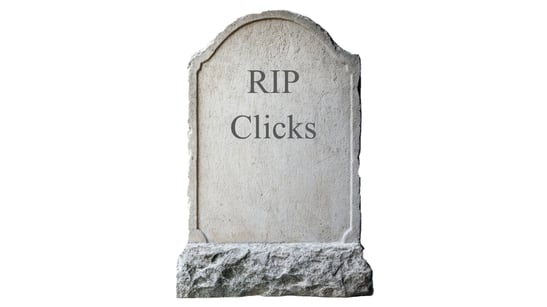
Why AI Overviews are increasing zero-click searches
Zero-click searches aren’t entirely new.
Search engines, like Google, have long displayed quick answers using:
- Featured snippets/answers
- Knowledge panels
- People Also Ask boxes/Answer boxes
But AI Overviews go much further.
Because they combine information from multiple sources, they can answer more complex and conversational questions. This often means users get everything they need without visiting another page.
Let’s be honest: this is a problem for B2B brands.
Especially when you’ve invested in content production, tweaked things according to algorithm updates, and optimised every page to within an inch of its life... only to then watch AI summarise your work and strip you of the click/traffic.
That’s not a small change.
That’s a fundamental rewiring of how search delivers value.
But writing SEO off wholesale would be a mistake. Because what’s actually happening is more interesting and more commercially useful.
AI Overviews aren’t killing SEO. They’re filtering it.
Rather than hitting copy + paste, AI Overviews are taking the available information and combing it for what matters. What really answers the user’s question.
So, the shift isn’t towards who ranks highest, but who can be trusted to provide the most accurate information.
And in B2B tech, where trust, credibility, and expertise already matter, that’s a big deal. So how do you ensure you're building this trust, credibility, and expertise in a way the AI can see?
The new SEO goal: Becoming an AI-citable source
Ranking #1 is old news.
The new game is how to be cited by AI. And that comes down to 4 things:
1. Topical authority
Surface-level content doesn’t get picked. If your blog could be written by anyone, it will be ignored by everything.
Own a niche. Go deep. Build a body of work, not a content calendar.
2. Clear, structured content
If AI can’t easily lift your insight, it won’t use it. That means:
- tight answers, early
- clean structure
- no waffle
Not for readability. For machine usability.
3. Credibility signals (E-E-A-T)
E-E-A-T (Experience, Expertise, Authoritativeness, Trustworthiness) isn’t new. But now it’s operational. If your content lacks:
- Real expertise
- Credible signals
- Identifiable authorship
It’s unlikely to make the cut.
Content written by knowledgeable authors and supported by credible sources performs better.
4. Original thinking
AI summarises. It doesn’t originate. So if your content is just:
- Reworded ideas
- Generic explainers
- “Ultimate guides” that say nothing new
It adds no value to the system. And gets ignored by it.
The winners will be the brands that bring something new to the table:
- Data
- POVs
- Experience
- Strong opinions (backed up)
When your content meets these criteria, you increase the chances of appearing in AI Overviews and gaining visibility even without direct clicks.

What B2B tech marketers should do differently
To succeed in AI-powered search, B2B tech marketers need to adapt how they create and structure content.
Here are four practical SEO strategies to improve your chances of being cited.
1. Answer questions clearly and early
Stop building up to the answer. Give it immediately and then expand. Because, if AI can’t find it quickly, it won’t use it.
Best practices include:
- Use short, concise answers (40–60 words work well)
- Structure information with bullet points or numbered lists
- Include clear definitions and summaries
2. Build topic ecosystems (not one-off blogs)
Publishing one article on a topic is rarely enough. Search engines prefer sources that demonstrate consistent expertise across multiple pieces of content.
You need:
- Connected content
- Internal linking
- Consistent depth
Think: “owning a conversation” rather than “covering a keyword”.
3. Create content AI can’t replace
This is the big one. If your content can be summarised without losing anything, it will be.
That means unique content becomes incredibly valuable. So build in:
- Proprietary data
- Real customer stories
- Expert-led insight
- Original thought
- Opposing viewpoints
That’s what gets cited.
And remembered.
4. Stop treating SEO like a channel
This is where most B2B teams are stuck. SEO doesn’t work in isolation anymore.
The brands that will win are those that are visible and building their brand consistently across multiple channels. Nobody ever bought from a brand they didn't trust, and nobody trusts a brand they've never heard of.
When users recognise and trust your brand, they are more likely to:
- Click on your link in search results
- Search directly for your brand
- Engage with your content across channels
Because AI doesn’t just read your website. It reads your footprint.
Measuring success in a zero-click world
Here’s the uncomfortable truth: traffic is a lagging metric.
In isolation, it no longer tells the full story.
Instead, marketers should pay attention to indicators such as:
- Are you showing up in AI answers?
- Is your brand being mentioned in-market?
- Are you influencing high-intent buyers earlier?
- Is organic contributing to pipeline—not just visits?
The focus is shifting from traffic volume to traffic quality. Because 500 highly relevant visitors > 5,000 casual ones. Every time.

The opportunity hidden in AI search
This shift feels like a loss. But for B2B tech marketers, it’s actually an opportunity.
Why?
Because most competitors are still playing the ranking game producing safe, generic content that is optimised for volume, not influence.
This creates space for sharper brands to:
- Own niche topics
- Shape buyer thinking
- Become the default trusted source
The key is to adapt early.
Organisations that evolve their content strategy now will be better positioned as AI-driven search continues to grow.
Conclusion: adapt or disappear
The zero-click era isn’t coming. It’s already here.
And it’s forcing a reset:
- From ranking → relevance
- From traffic → trust
- From content → authority
Ultimately, the question is no longer:
“How do we rank number one?”
Instead, it’s:
“How do we become the source AI trusts?”
Because the brands that can confidently answer this question, are the ones that will still be driving pipeline long after everyone else is wondering where their traffic went.


%20gap.png?width=347&name=Mind%20the%20(b2b%20marketing%20resource)%20gap.png)